Know Which Component Is Wearing Out, Before It Fails
A health twin runs beside each power converter in the field. It compares what the converter does with what a healthy one would do, names the component that is drifting, estimates how far it has drifted, and tells your team what to do about it.
Results from our LLC resonant converter study, validated against Simscape switching simulations.
The Challenge
Why Converters Still Fail Unannounced
Power converters sit at the heart of data centres, EV chargers, solar plants and industrial drives. Their components age: capacitors lose capacitance, magnetics drift, semiconductors lose efficiency. Most fleets still handle this in one of two ways: replace on a fixed schedule and throw away healthy parts, or run to failure and accept the downtime.
Monitoring the converter's outputs should help, but its currents and voltages change all the time with load and line conditions. A small fault hides inside those normal changes. To see it, you need to know what a healthy converter would do at this exact operating point, computed in real time, on the device.
Fixed schedules waste parts, run-to-failure wastes uptime
Neither approach knows the actual condition of the unit in front of you.
Threshold alarms say "something is wrong", not what
A drop in efficiency could be a capacitor, a magnetic component, a semiconductor, or simply a different load.
A drifting sensor looks like a failing converter
Healthy units get swapped and come back as "no fault found", while the real cause stays in the field.
How It Works
A Healthy Twin, a Fault Library and a Kalman Filter
The twin sees the same operating conditions as your converter and predicts what a healthy unit would measure. Any gap between prediction and measurement is matched against a library of known faults.
Nominal ROM
A reduced order model of your converter, trained on your own simulation model. It predicts the measured outputs at any operating point, fast enough to run on embedded hardware.
Fault library
For every failure mode you care about, the fingerprint it leaves on the measurements across the operating envelope. It is built from paired healthy and degraded simulations, so no field failures are needed.
Kalman filter estimator
A bank of Kalman filters tests each fault in the library against the live data, ranks them by evidence and estimates the fault size with an uncertainty. A fault is named only when the evidence is strong, consistent and large enough to matter.
Self-commissioning
At first power-up the twin learns the unit's own healthy fingerprint, including its component tolerances. From then on it reports change relative to that unit, not to a datasheet.
Getting Started
From Your Simulation Model to the Field
Six steps take you from the model your engineers already have to a health twin running on every unit. You keep your model and your data.
-
1
Scope the failure modes
You provideYour converter's simulation model (Simscape, PLECS or similar), its operating envelope, the measurements available on the product, and the failure modes that cost you most: capacitor ageing, magnetics drift, semiconductor degradation, sensor drift.
We deliverAn observability check: which faults leave a fingerprint your sensors can see, which cannot, and what one extra measurement would add.
-
2
Run the parameter sweeps
You provideCompute time on your own tools and licences, or let us run the campaign for you. Nothing leaves your premises unless you choose.
We deliverA ready-to-run simulation campaign: a space-filling sweep of the operating envelope, plus paired healthy and degraded runs for each failure mode, with scripts that slot into your simulation environment.
-
3
Build the nominal ROM
You provideA review of the ROM against your own reference cases or bench measurements.
We deliverA real-time ROM of the healthy converter, validated on simulation runs it never saw, with an accuracy and speed report.
-
4
Build the health twin
You provideYour sensor chain (resolution, noise, sample rate) and the action each diagnosis should trigger in your maintenance process.
We deliverThe fault library and a Kalman filter estimator tuned to your sensors, validated on operating points held out from training, including a false-alarm check in healthy operation.
-
5
Deploy to the edge
You provideIntegration into your firmware, gateway or monitoring stack. At first power-up, each unit commissions its own twin automatically.
We deliverThe twin as dependency-free C code for your controller, or as a container for a gateway or server. See deployment formats.
-
6
Operate and improve
Diagnoses flow into your maintenance system: the component, how far it has drifted, how confident the twin is, and the recommended action. As field data accumulates, it confirms and refines the fault library across the fleet.
The Output
A Diagnosis Your Technicians Can Act On
Example reports from the LLC resonant converter study. Each names the component and the size of the drift, and recommends an action.
| Failure mode | Twin reports | Recommended action |
|---|---|---|
| Resonant capacitor ageing | Cr −15 % | Plan a module swap in the next maintenance window |
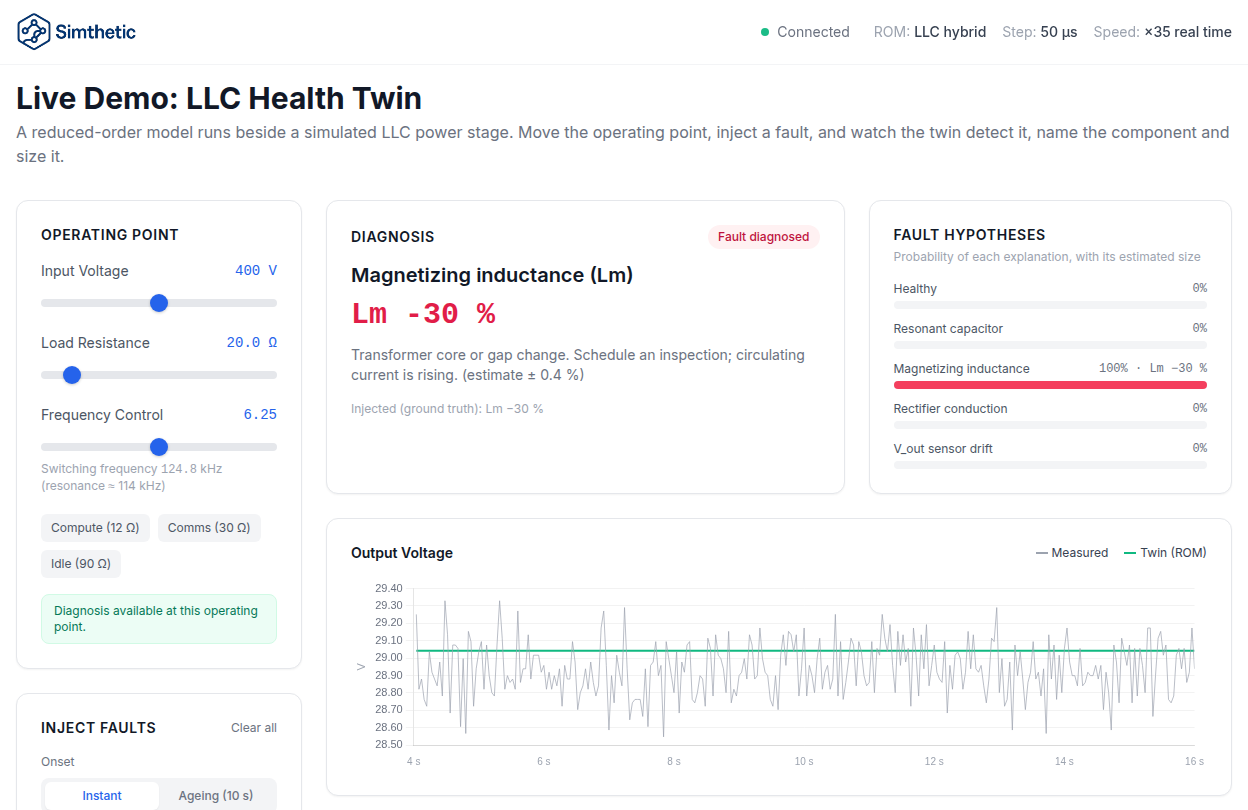
| Transformer magnetizing inductance drift | Lm −30 % | Inspect the transformer; circulating current is rising |
| Rectifier conduction degradation | Ron +60 % | Rising conduction loss; check cooling and plan a replacement |
| Output-voltage sensor drift | gain +1 % | The converter is healthy. Recalibrate or replace the sensor; do not swap the unit |
Benefits
What You Get Out of It
Planned, not emergency, maintenance
Degradation is flagged while it is still small, so the replacement goes into the next scheduled window instead of a call-out.
Less unplanned downtime
Units are swapped before they fail, so redundancy is not consumed by surprise failures and service levels hold.
The right part, first time
Technicians arrive knowing which component is drifting and by how much. Fewer swap-and-test visits, fewer spares on the truck.
Fewer "no fault found" returns
Sensor drift is told apart from a real converter fault, so healthy units stay in service and the actual cause gets fixed.
No extra hardware
The twin uses measurements the converter already makes and runs on hardware you already have. Our LLC ROM runs 3.9× faster than real time on an Arm Cortex-M7.
Insight across the fleet
Every unit logs the size of each drift over time. See which components age fastest and where, and feed it back into design, sourcing and warranty decisions.
Proof of Concept
Proven on a 100 kHz LLC Resonant Converter
We built a health twin for the LLC DC/DC stage found in server power supplies and EV chargers, following the same six steps, and validated it against Simscape switching simulations.
- Three component faults and a sensor fault told apart, each with its size.
- All 15 cases correct at an input voltage the fault library never saw, with sizes within 7 %.
- A slow transformer drift is flagged at about −7 %, long before it reaches −30 %.
- No false alarms in healthy operation.
Have a Fleet of Converters to Keep Running?
Tell us about your converter and the failures that cost you most. We'll tell you which of them a health twin can catch.