Why full-order models fail in production
Plant models are widely used in many industries for prototyping, control and system integration. These detailed models, particularly of physical systems such as power electronics, thermal systems, mechanical systems, are based on mathematical equations which must be solved for every simulation step. Depending on the time constants of the underlying physical system and the selected solver, this could mean that these simulation models are computationally heavy, so much so that they can only be used to simulate very short periods of time (e.g. 1ms), and still need several minutes to compute.
While these models are almost certainly reflecting the real physical system (e.g. high-fidelity), assuming correct setup of all parameters, their practical utilization is limited by computational power and time. A power electronics engineer who is trying to define a control strategy for his topology, may be stuck with open loop step response simulations, limiting his capability of understanding the system as a whole for a wider range of scenarios, and being forced to fully validate it on a physical testbench, which is both cost and time consuming to setup.
Trade-offs: accuracy vs speed vs robustness
For a significant amount of applications however, the engineer may not need such a detailed plant model. Steady-state behavior with some low order dynamics may be more than enough to have a good baseline of a PI controller for a Buck converter. The detailed and heavy plant model could be replaced with a simplified reduced order model (ROM) for some purposes, expanding the temporal horizon of engineers in a simulated environment and opening up new testing scenario possibilities.
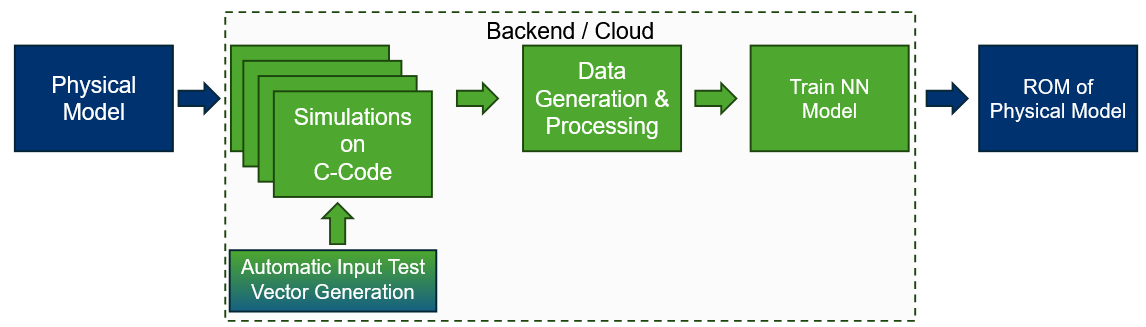
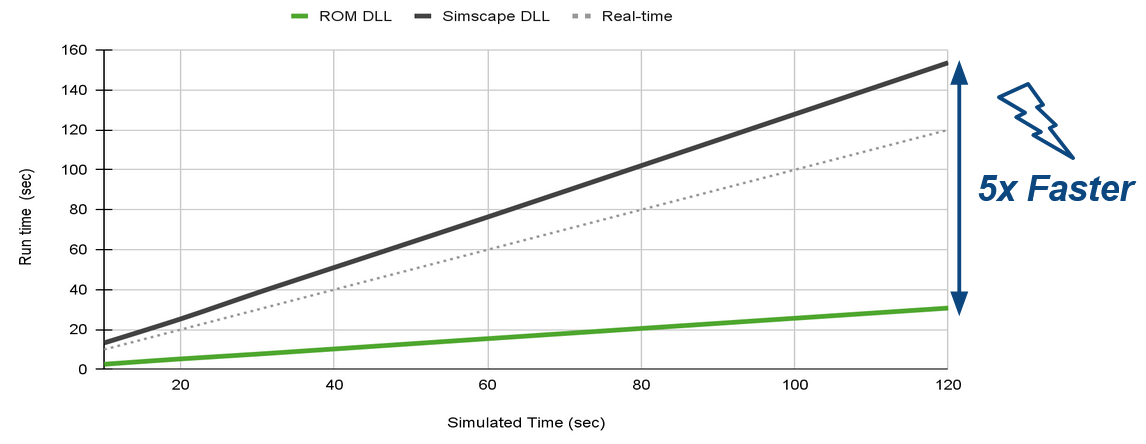
The ROM is obtained by distillation of the larger, more complex and accurate detailed physical model. It retains as much knowledge as we wish – it can become almost as accurate as the detailed model, at the cost of execution speed, or we can compromise on accuracy to have a very fast ROM. Improvements typically range from 5x to 100x in terms of computational speed-up, turning days of simulating and waiting into seconds.
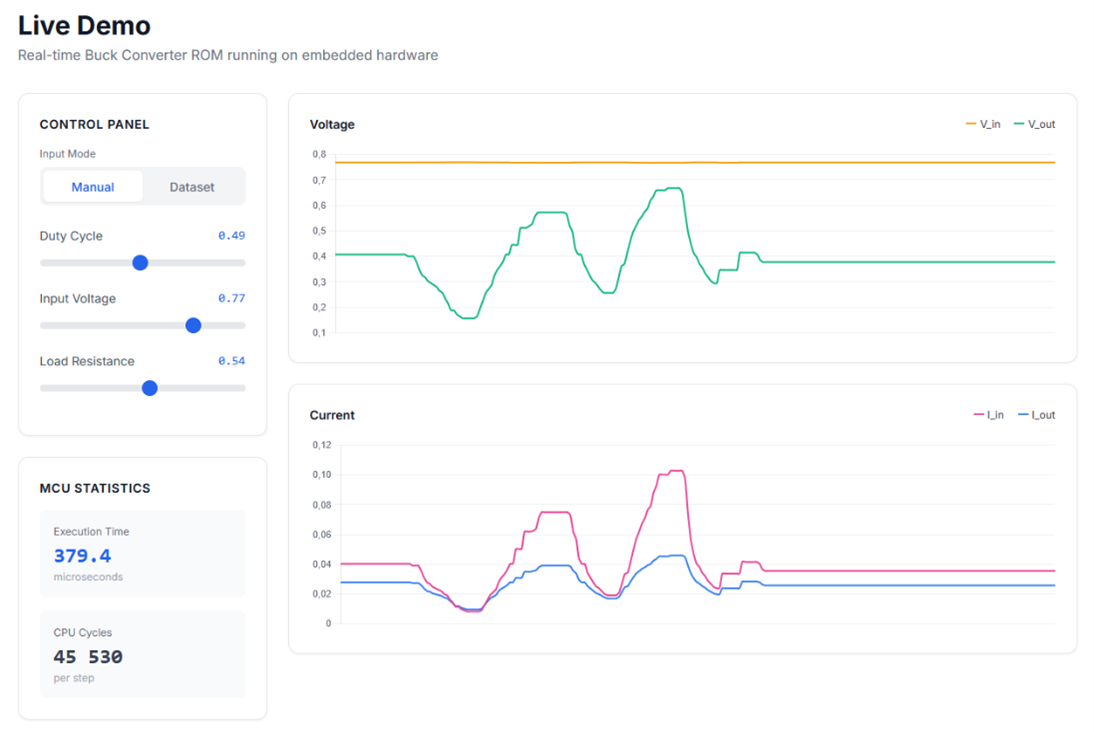
These ROMs can be tiny, so much so that they can fit inside an embedded system like an MCU or FPGA, while running in real-time and retaining accuracies well over 95%. Such embedded deployments also create incredible potential opportunities, such as virtual sensors, improved diagnostics and edge digital twins used for predictive maintenance. ROMs can also be deployed into HIL systems, bridging the gap between laptop simulation and hardware or mechanical prototyping.
While these ROMs will inevitably have a slightly reduced accuracy compared to the physical model, they can be set up to be robust and consistent. By employing physics-informed architectures or rigorously bounded state-space models, we can ensure they do not hallucinate physical behaviors or become unstable, which is a factor of paramount importance in safety-critical applications like automotive, aerospace and railway.
Validation strategies engineers trust
Since the ROM relies on the "teacher" model of the high-fidelity physical model, it is simple to figure out where the model is regarding accuracy and robustness. Running back-to-back tests allows us to create clear metrics of performance of the ROM, empowering teams to make informed decisions regarding the optimal balance between computational footprint and model accuracy.
How Simthetic bridges the gap
Simthetic allows engineers to focus on their core domain expertise – whether in power electronics, thermal, or mechanical engineering – while seamlessly leveraging machine learning to create ROMs, without requiring any prior data science knowledge. Simthetic takes care of the complex and tedious task of setting up a ROM for your detailed physical model, which would normally take a specialized team in mathematics and machine learning.
The process is straightforward and fully automated, ensuring your engineers can immediately deploy these models in their applications. Try our live LLC Health Twin demo right in your browser, or reach out to discuss how Simthetic can accelerate your simulation pipelines today.